Human Resources Excellence in Research Award

The HREIR Award at the UPPA
Having been awarded the Human Resources Excellence in Research (HREIR) Award as of 2020, the Université de Pau et des Pays de l’Adour (University of Pau and the Adour Lands, UPPA) is committed to renewing this European accreditation, which recognizes institutions that implement a human resources policy that supports research, in accordance with the principles of the European Charter for Researchers.
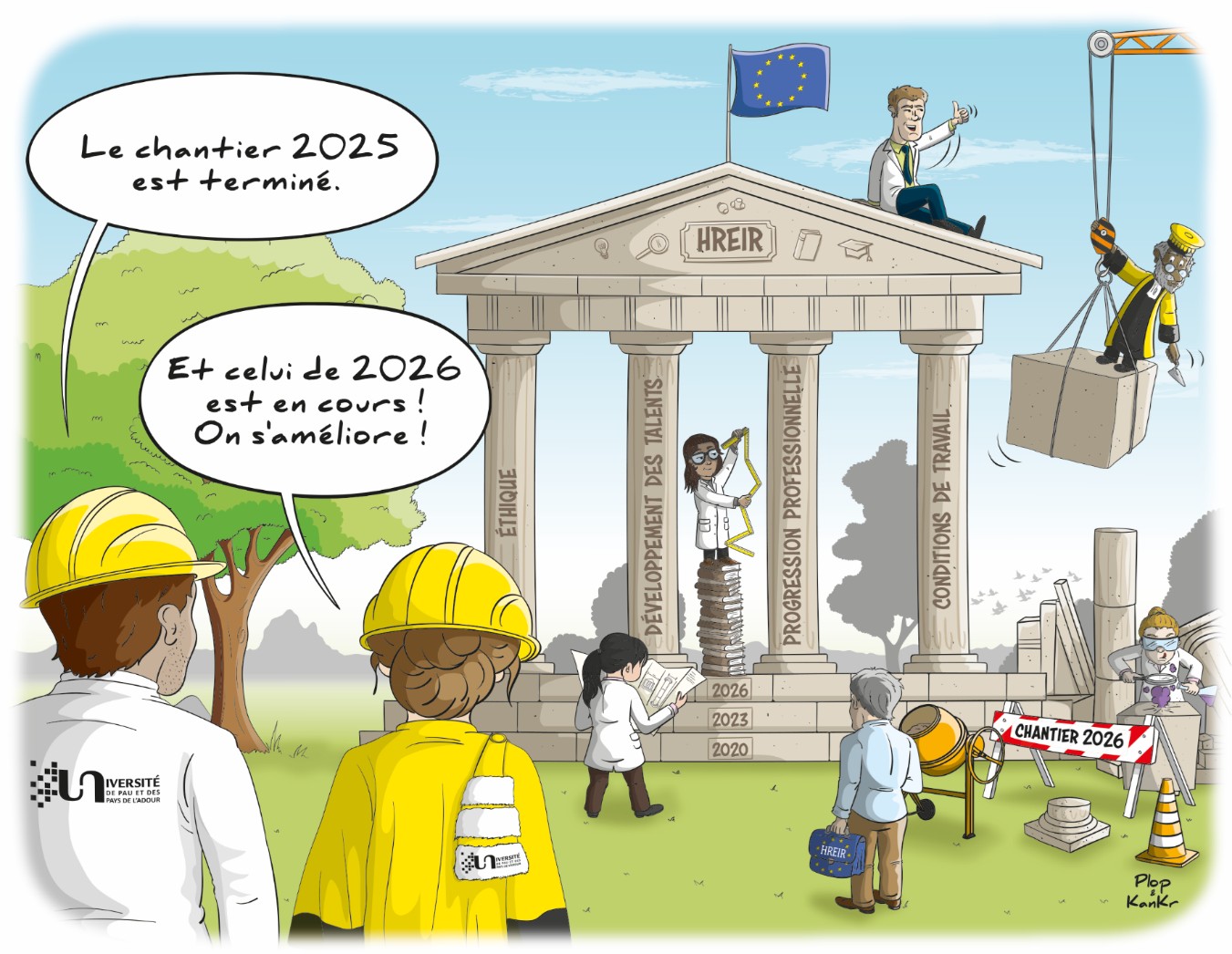
At the UPPA, this approach is constantly evolving and being enriched thanks to the involvement of the entire university community — researchers, research support staff, administrative managers and governing bodies — working together toward a shared ambition: to consolidate this momentum and continue the initiatives already underway to create an ever more attractive research environment.
In 2026, the renewal of the award marks a new stage in the UPPA’s commitment. It is aligned with the framework set out in the European Charter for Researchers and its four founding pillars:
- Ethics, Integrity, Gender and Open Science;
- Researchers’ Assessment, Recruitment and Progression;
- Working Conditions and Practices;
- and Research Careers and Talent Development.
Far more than a simply formal recognition, this award is a real catalyst. It enables:
- The strengthening of an HR policy focused on continuous improvement, for the benefit of all staff;
- Increased international visibility for the university to attract talent and compete for European funding;
- And to form part of a comprehensive approach, working in synergy with the university’s other projects as well as with the major challenges facing higher education and research.
Key stages of the award process
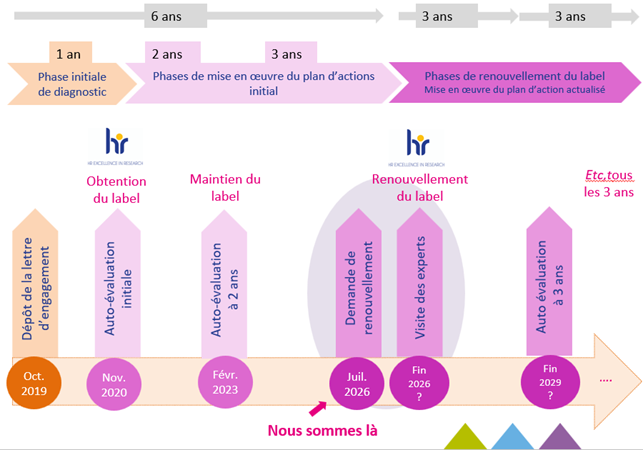
This timeline illustrates the HRS4R label lifecycle. Following a one-year diagnostic phase and the implementation of an initial action plan, the institution obtained the HRS4R label in November 2020. A first self-assessment was completed as part of the initial process, followed by a two-year self-assessment in February 2023 to maintain the label. The current position on the timeline is July 2026, when the institution is preparing its label renewal application. An expert review visit is expected later in 2026. Once renewed, the label is maintained through recurring self-assessments every three years, with the next review scheduled for 2029 and subsequent reviews every three years thereafter.
Since 2020, the UPPA has developed its HRS4R approach in line with its institutional strategy, to the point of embedding it firmly in its practices. The new 2026-2029 action plan illustrates this maturity and the alignment between the HRS4R plan and the institution’s policy, which is structured around four complementary strategic ambitions. These form the basis of the UPPA’s commitment in the Objectives-Means-Performance Contract (COMP) signed with the French State for 2026-2030:
- Advancing knowledge and skills to better address the challenges of energy, environmental and societal transitions;
- Working towards the socio-economic, cultural and international development of the southern Aquitaine regions;
- Ensuring an inclusive and fulfilling working environment;
- Reducing the institution’s environmental footprint.
The HRS4R approach provides the UPPA with an opportunity to consolidate this ambitious trajectory, which is based on a commitment to excellence in research on transitions, the development of partnerships and innovation, internationalization, the diversification of its educational offering, and support for student success. Each action in the plan is therefore linked to one or more of the roadmaps that form the framework of the UPPA’s strategy.
The UPPA’s HRS4R was developed through two complementary strands underpinned by tangible actions:
- Consolidating the dissemination and adoption of the approach amongst all relevant communities;
- Publication of articles dedicated to each of the four pillars in the institutional monthly newsletter,
- Creation of a dedicated visual aid (the HRS4R totem),
- Engaging the joint management committees of the three colleges,
- Presenting the progress and outcome of the project to the Research Commission, the Academic Council and the Executive Management Committee.
- Ensuring that the development of the action plan is a resolutely participatory exercise, involving staff in jointly establishing the priorities for the coming years:
- Workshops documented and informed by a gap analysis, organized with researchers, teacher-researchers, PhD students and administrative staff,
- Reports summarizing the work carried out in the workshops, to serve as a basis for further work and for prioritizing actions.
On the 1st of July, 2026, the UPPA submitted its Internal Review via the European platform. The university is awaiting feedback from the European Commission on its review and the on-site visit by experts.
- Consolidating the dissemination and adoption of the approach amongst all relevant communities;
PILLAR 1: Ethics, Integrity, Gender and Open Science (Article from the January 2026 monthly newsletter)
- Ethics and Research Integrity
- Freedom of Scientific Research
- Open Science
- Gender Equality
- Embracing Diversity
- The Researcher
- Free Circulation of Researchers
- Sustainability of Research
PILLAR 2: Researchers’ Assessment, Recruitment and Progression (Article from the February 2026 monthly newsletter)
- Researchers’ Assessment
- Recruitment
- Sélection
- Evolution de carrière
PILLAR 3: Working Conditions and Practices (Article from the April 2026 monthly newsletter)
- Working Conditions, Funding and Salaries
- Stability of Employment
- Contractual and Legal Obligations
- Dissemination and Exploitation of Results
PILLAR 4: Research Careers and Talent Development (Article from the May 2026 monthly newsletter)
- Valuing Diverse Research Careers
- Career Development and Advice
- Continuous Professional Development
- Supervision and Mentoring